

It’s probably hard to find a person who hasn’t heard of dental implants by now. In modern dentistry, implants are the most technologically advanced and reliable way to restore a lost tooth. But what should you do if all or almost all of your teeth are lost and destroyed?
There are only two options in this case: either use a simple, cheap, but extremely uncomfortable “false jaw”, i.e. a removable prosthesis, or the All-on-4 and All-on-6 prosthetic system, which provides full restoration of aesthetics and the same quality of life as natural teeth.
A little historyAfter implant dentures proved to be highly effective and became widespread, dentists experimented with extending the functionality of this remarkable technology. In the 1990s, a prosthetic system was first developed where a complete denture was attached to four specially placed implants. It was this system that formed the basis of the All-on-4 technique. Of course, today’s prosthetic protocols and technologies are much improved and very different from the systems of the 90’s, but the general principles have remained unchanged.
What is the essence of the methodologyAll-on-4 (all-on-four) and All-on-6 (all-on-six) are full denture restoration techniques, where a fixed denture is attached to 4 or 6 specialized implants.
In the case of the All-on-4 protocol, two implants are placed in the frontal plane and two are placed near the fifth teeth at an angle that can range from 35 to 45 degrees.
The All-on-6 technique involves placing 2 implants in the frontal plane and 4 more at an angle in the lateral regions. When the prosthesis is attached to 6 implants, the load is more evenly distributed, which increases the reliability of the structure.
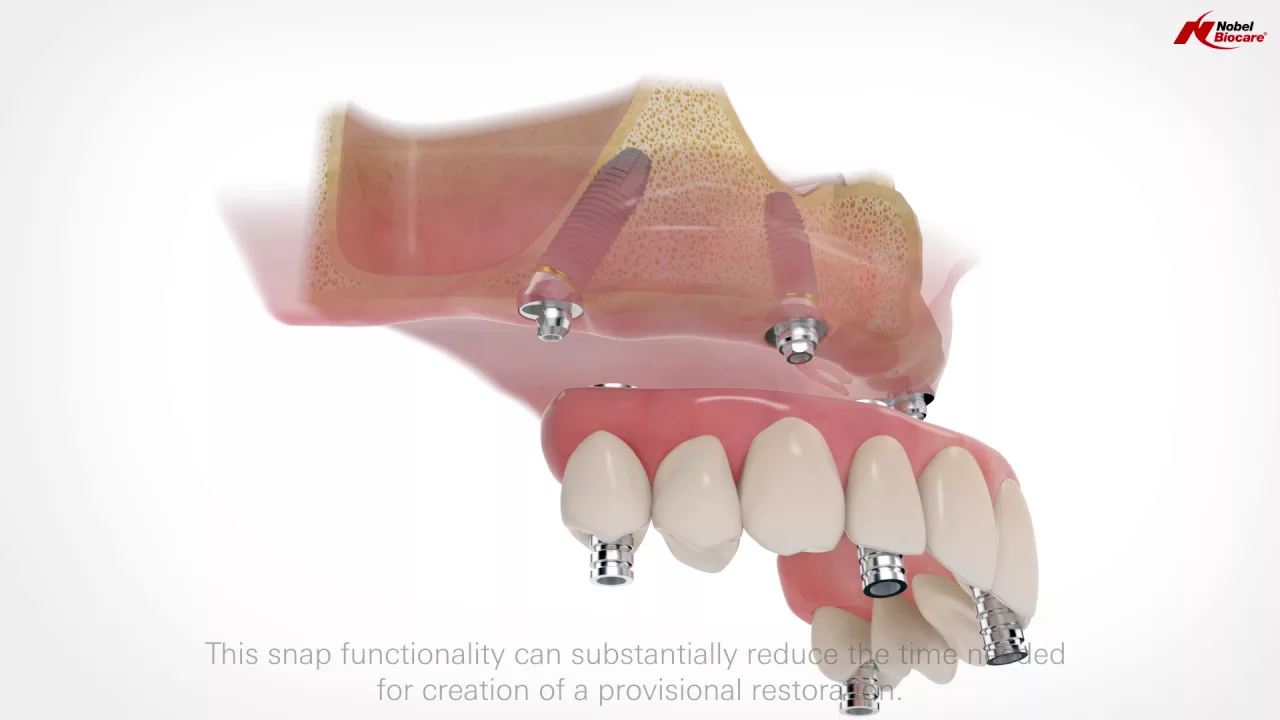
The indications for the All on 4 and All on 6 implant techniques are identical, these are:
- All or most of the teeth are missing
- Indications for complete tooth extraction
- In generalized periodontitis with significant bone loss
- Presence of bridges with poor prognosis
- Decayed teeth or teeth showing signs of mobility
Chronic gum disease, periodontitis and periodontal disease with bone loss and teeth mobility are direct indications for All-on-4 and All-on-6 prosthetics
Many factors influence which of these techniques should be used in each specific case, the main one being bone volume and density.
In order to install the All-on-4 system, a larger volume of bone is required – the width of the bone must not be less than 5 mm, the height for the upper jaw must not be less than 10 mm and for the lower jaw – 8 mm, and the bone tissue must have the necessary density. There are fewer restrictions for the All-on-6 system, as the 6 attachment points allow for a more even distribution of the load and the use of shorter implants
In any case, the decision on which prosthetic method to use should be entrusted to a specialist who will take into account all factors and individual characteristics and, accordingly, the prognosis of treatment.
And how do you save your remaining teeth?If there are intact healthy teeth, it is better to abandon the All-on-4 and All-on-6 systems and use the classical implantation method (of course, if the state of the bone tissue allows it). In this case, at least 6 implants will have to be placed on the lower jaw, and 8 implants will have to be placed on the upper jaw, on which bridges will be attached. In this way, it will be possible to completely restore the tooth row (of course, without “eights” or wisdom teeth)
Why is it important to try to maintain healthy natural teeth, even if there are only a few left? Because a natural tooth has proprioceptive sensitivity, i.e. it is a receptor that transmits information to the brain about the load of chewing. The brain analyzes the hardness of the food we chew and adjusts the work of the masticatory muscles. Even with a single tooth, proprioceptive sensitivity is still present, but it disappears completely when the natural teeth are missing.
Therefore, we recommend All-on-4 and All-on-6 prosthetics only in cases of complete loss or impossibility to save teeth, or in those cases when classical implantation is not possible due to certain indications
How All-on-4 and All-on-6 implants are performed First stage: diagnosisComprehensive diagnostics is essential when planning such a complex procedure. A computed tomography (CT) scan to assess bone thickness and density is mandatory, followed by a virtual simulation of the implantation and subsequent prosthesis to accurately assess the location of the implants, the angle of their inclination, and the design of the prosthesis itself. A surgical template is made, which will ensure the accuracy of the subsequent implantation. Impressions are also made for the fabrication of a temporary structure (prosthesis)
Stage two: implantationAll-on-4 and All-on-6 prosthetics not only allows you to restore the tooth row, but also to hide jaw defects, restore the bite, and of course, aesthetics
This stage is sometimes also combined with the removal of the remaining destroyed roots. Implantation can be carried out under local anesthesia, but more often with such a large surgical intervention is recommended to carry out the operation under medication sleep. Immediately after implantation, the first temporary denture is placed, which will be replaced after 2 weeks
The duration of the operation is 2-3 hours, and another hour is required for making impressions or 3d models of the second provisional denture. Another half hour or so may be required for fixation of the first provisional.
After this step is completed, a follow-up CT scan is done to ensure that all implants are correctly placed
Based on the impressions or 3d template obtained in the second stage, a second temporary structure is fabricated in the laboratory. It is more accurate because the impressions were taken after the implants were placed. And, usually, two weeks after the operation is carried out fixation of this more accurate design, which will remain in the patient’s mouth for the next six months.
The duration of the appointment with the process of fitting and fixing the structure will be an hour to two hours
Over the past six months, the integration (engraftment) of the implants takes place, the gum subsides, the tissues adapt and it is possible to proceed to the stage of fabrication and then fixation of the permanent ceramic prosthesis. The long but very important process has come to an end: aesthetics and chewing function are fully restored, and your smile is pleasing to you and others
What does a denture look like?The stage of fabrication of the first temporary is not obligatory. Refusing the first denture will save you a substantial amount of money and significantly reduce the duration of manipulations, but will force you to do without teeth for a week or two. The choice in this case is always up to the patient
In the case of the All-on-4 technique, a 12-tooth bridge (up to and including the “six” teeth) is fabricated. In the case of the All-on-6 technique, it is possible to fabricate a bridge of 14 teeth, up to and including “sevens”
Advantages of All-on-4 and All-on-6 techniques- A fixed denture is disproportionately more comfortable and convenient than a removable “granny jaw” type denture
- Diction and chewing function are fully preserved
- It does not overlap the palate, and therefore, the flavor of the food is fully felt
- Excellent aesthetics – the prosthesis is indistinguishable from natural teeth. The result is often better aesthetically than classical implantation.
- Fewer contraindications and restrictions than classical implantation
- One surgical intervention instead of several bone grafts and implantations with the classic technique
- Immediately or almost immediately (if the first temporary is not placed), the tooth row and aesthetics are restored
Compared to the classic removable prosthesis, the All-on-4 and All-on-6 systems have only one disadvantage – the high cost. In terms of comfort and quality of life, these implant systems are so superior to removable prosthetics that they cannot even be compared.
It’s importantAll-on-4 and All-on-6 techniques require extremely high qualifications from the doctor and appropriate clinic equipment. Therefore, choosing the right clinic is of paramount importance.
The specialists of City Smile Dental Center have extensive experience in performing All-on-4 and All-on-6 operations even in complex clinical cases and can guarantee the highest quality and reliability of prosthetics
Never look for the cheapest options, read reviews and testimonials. This is not a case where you should take any risks.
Implants are guaranteed for 10 years, but their lifespan is usually many times longer. In the vast majority of cases, you can assume that the structure will last a lifetime.
How soon after implantation can I eat solid food?You can chew food as early as 4 hours after insertion of the temporary denture. Uniform and soft food is recommended for the first few days, then avoid hard food for a few months. After 2-4 months, you can resume your usual diet, but still be careful. After 6 months after the procedure, you can eat as usual. Of course, there are restrictions – you should definitely not chew on breadcrumbs or something very hard.
How often do I need to be seen by a specialist after the structure has been installed?Hygienic cleaning should be done at least twice a year.
Can both jaws be implanted in one appointment?Yes, it’s fine, unless there’s a contraindication.
Will food residue not accumulate under the denture?The denture is fixed quite tightly, so food does not get under it, but it is not unreasonable to rinse your mouth after eating. The same recommendation applies to natural teeth.
What should I do if an implant or denture breaks?Implants will not break, they are designed for high loads and many decades of service. There is a slight risk of rejection, so it is worth seeing a specialist if you experience minimal discomfort. The prosthesis is also highly durable, but, nevertheless, it can be damaged by very hard food (do not chew breadcrumbs and nuts) or in case of trauma. In this case, depending on the situation, either repair or replacement of the denture will help.
Any questions?Call and we’ll be happy to answer them!
