

The crown represents one of the most effective and efficient solutionsThe crown is one of the most effective and efficient solutions for restoring a smile and healthy teeth. Кoronchi are the most aesthetic option for restoring teeth. This is due to the optical and physical characteristics of the materials from which they are made.
Another advantage of crowns is that they are biologically neutral and therefore fully compatible with the patient’s body. When properly placed, the new crown does not cause any hassle to its owner and is visually indistinguishable from a vital tooth.
Dental crowns are used in dentistry to restore damaged, broken, dead or severely decayed teeth that no longer have healthy tooth structure to support a new filling or veneer. Crowns can strengthen and beautify these teeth, especially if several teeth need to be reconstructed side by side. A crown can be thought of as a kind of cap that is fixed to the natural tooth.
Dental crowns are indicated when significantly damaged teeth can still be saved. teeth, but if the pulp is intact and root canal treatment can be performed. root canal treatment..
Sometimes it is necessary to fabricate and place a post that will be anchored into the root of the tooth before the crown is placed. A crown post is also necessary if the natural tooth structure is destroyed after root canal treatment. In these circumstances, a hinge is needed to properly support the crown.
Crowns, like veneers are used in several applications:
- Restoration of rotted or broken teeth, if possible to completely cover the damaged tooth.
- Replacing teeth that have discolored over time, tooth “dead” (not viable after root canal treatment) or deformed teeth.
- Improvement of the smile in terms of uniformity of tooth color, shape and function.
- Crowns provide an aesthetic appearance and function similar to natural teeth.
- They are as stable and hard as natural teeth, making it possible to restore normal chewing function.
- They are glued (cemented) in the mouth, unlike removable dentures, Because they are fixed in the mouth, they are more stable than other types of dentures.
Placement of a crown usually requires several steps performed in at least two sessions:
- During the first appointment, the dentist must prepare the tooth on which the crown will be placed. This is done by grinding to make the final crown fit the natural tooth. The procedure is performed under local anesthesia.
- Also during the initial appointment, impressions are taken of the tooth being replaced to create a working model that will be used by the prosthodontist or dentist who will fabricate the crown in the lab. At this stage, a temporary crown, often made of acrylic, may be placed while the final crown is being fabricated.
- Together, the dentist and prosthodontist ensure that the final crown will perfectly match the remaining natural teeth by checking several parameters, including the color and shape of the adjacent teeth.
- When the crown is ready, often within a few days of placement, another visit is needed to finalize the crown on the tooth.
- If there are caries or or gum disease.These should be treated before considering a crown.
- Bruxism (teeth grinding or clenching) can damage or even break crowns, depending on the material used, or even damage healthy teeth if the crowns are made of a material more resistant than enamel.
Depending on the method of fabrication, there are 4 types of dental crowns often used:
- Ceramic crowns;
- Zirconium crowns.
- Metal-ceramic crown;
- Metal crowns;
As the name implies, a ceramic crown – is an artificial ceramic crown built on a ceramic base rather than a metal base.
The most notable advantage of ceramic is its aesthetics. This translucent material actually looks very similar to the enamel of a natural tooth. Ceramics are also biocompatible, which means that they harmonize with the body and integrate perfectly with it.
Such features of ceramics as increased hardness but also brittleness make it advisable to place these crowns only on the anterior teeth, due to the less chewing load they are subjected to. The service life of modern ceramic crowns is 5-10 years, while zirconium oxide crowns last 15 years or more.
On the other hand, an all-ceramic crown is contraindicated in case of a significant bite disturbance and improper contact between the upper and lower teeth, as well as for certain types of teeth. Ceramics are less stable than metals and can break or be damaged by repeated contact with other teeth.
Placement of an all-ceramic crown requires the same steps as an all-ceramic crown, except that a metal-ceramic base is not fabricated.
E-max Ceramics is a lithium glass ceramic used in dentistry for the fabrication of dentures. E-max Ceramics was developed by Ivolar Vivadent, a world leader in dental ceramics based in Liechtenstein.
Unlike a metal-ceramic crown, the E-max crown transmits light like a natural tooth. This property, of course, makes a huge difference when the patient smiles, as the crown will not be visible.
Zirconia crowns are attractive because they have many benefits.
A zirconia crown has several advantages that allow it to offer a much more interesting solution than all other types of crowns that are usually offered by dentists in Ukraine.
- The core of a zirconia crown is made using computer-aided design techniques, resulting in a perfect result and a crown that fits perfectly into the patient’s jawbone.
- The inside of a zirconia crown is made of zirconium oxide, a white material that transmits light. This feature allows the zirconia denture to behave just like a real tooth, allowing it to blend in perfectly with other teeth.
- The zirconium oxide that forms the basis of a zirconia crown has better mechanical properties than other commonly used dental materials, but is also much more resistant. Thus, zirconium crowns have a much longer lifespan.
- A zirconium dioxide crown does not transmit an electrical charge and also provides greater resistance to cold and heat.
- Zirconium crowns have great resistance to mechanical stress, which allows them to be used to replace molars, which are subjected to the greatest pressure during chewing.
- These crowns do not contain allergenic materials, so they can be used in patients with allergies.
- Zirconia crowns have greater resistance to infection.
This type of denture combines the strength of metal with the aesthetic qualities of ceramic.
When patients need to restore single gaps in the chewing row or several teeth in a row, specialists most often recommend metal-ceramic dentures. As the name implies, these dentures consist of a metal base and a layer of annealed natural mineral composite.
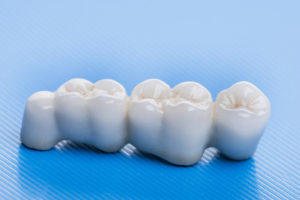
Modern cobalt-chromium or nickel-chromium alloys as well as precious metals are used for the production of the metal base. Thanks to this, metal-ceramic crowns have the physical properties required in this case. Once professionally fabricated and fitted, metal-ceramic crowns can withstand more stress than conventional ceramic crowns, which is why they are preferably used in the chewing section of the dentition. Depending on the materials used, metal-ceramic crowns last 7-8 years, while gold-ceramic crowns last up to 20 years. Unfortunately, along with their advantages, metal-ceramic dental prostheses are not without some disadvantages.
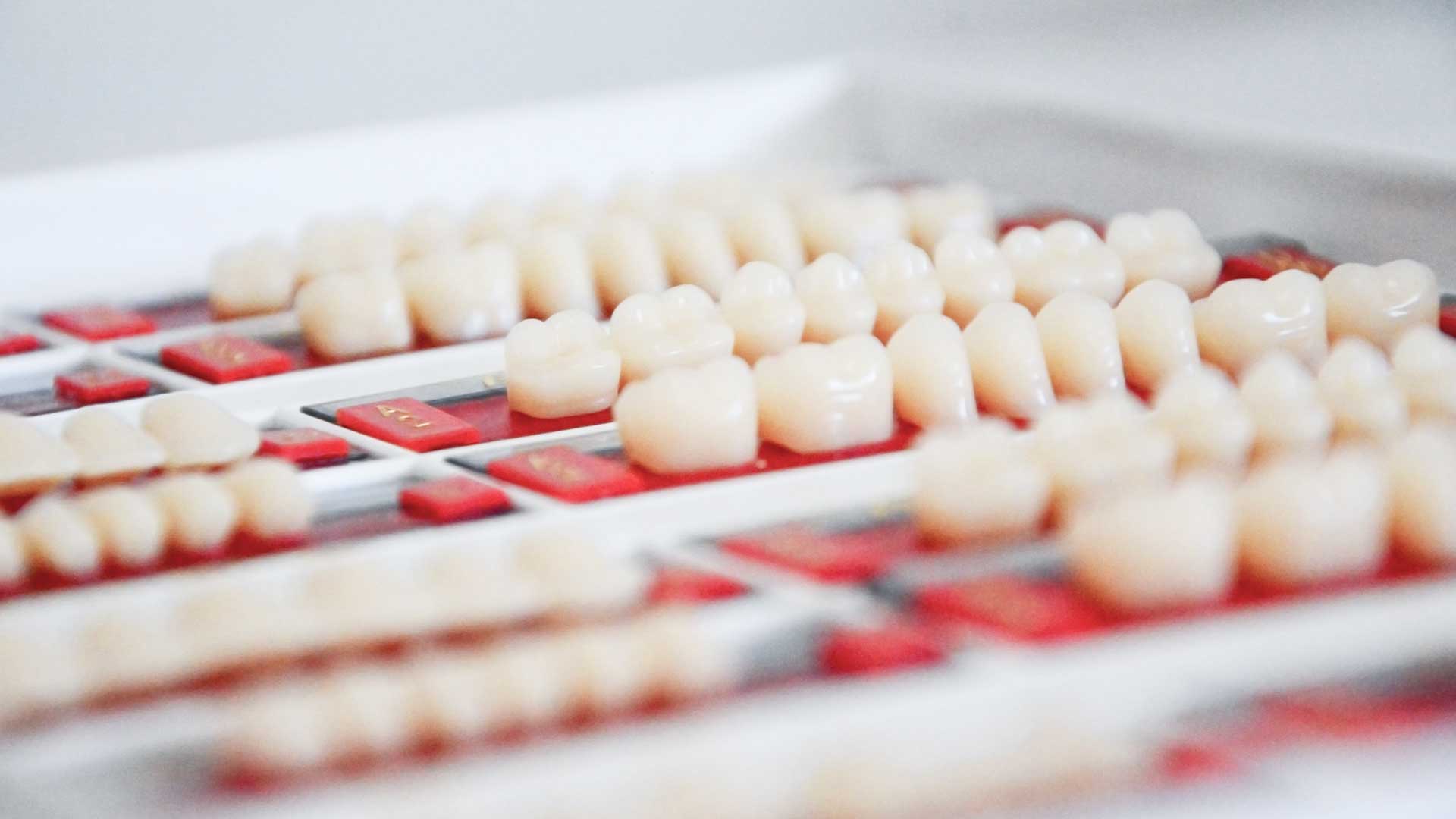
For example, in order to install them, it is necessary to first treat and close the tooth canals, to prepare (grind) the tooth to a cone-shaped form or to install a stump-supporting inlay. In rare cases, it is also possible that the patient’s body may react to contact with metal in the oral cavity. When fitting metal-ceramic prostheses, the qualifications of the specialists involved in this process are extremely important.
Also, over time, gum tissue wears away naturally and exposes the metal of the crown – the thin gray border that can be seen on the neck of the tooth.
In general, nowadays, dental restoration with the help of metal-ceramics has gained wide popularity precisely because of its relative affordability and good final result.
City Smile Dental Center recommends quality metal-ceramic crowns to its patients as an affordable and proven method of tooth restoration.
Metal crowns are usually made from an alloy of chromium and nickel. There are also dentures made of chromium and cobalt. Other metal alloys may be used.
These crowns are uncommon because they represent the least aesthetic solution for restoring a tooth. They offer a rather limited aesthetic result due to their metallic appearance, which does not blend in with the rest of the teeth. Thus, these metal crowns are designed for less visible teeth, most often those located in the back of the mouth.
The placement of dental crowns is a fully supervised procedure that poses little risk. However, in some cases, dental crowns can cause certain problems that may be uncomfortable for the patient.
Pain
The placement of dental crowns can cause mild pain in the first few days after placement. In addition, pain occurs especially when the patient has not had temporary polymer dental crowns placed in the days leading up to the placement of permanent dental crowns. The appearance of these pains is due to a gum device that may have lightly covered the crown, which can cause mild pain for a few days.
Itching
The itching sensation after crown placement is usually a phantom sensation, as it is caused by a slight compression effect. This sensation subsides on its own after a few days.
Abscess
An abscess is is the most serious complication that can occur after the placement of dental crowns. However, the appearance of an abscess is not really the result of a dental crown, as it is more likely related to the devitalization surgery that preceded the placement of the dental crown.
Allergies
It is possible to put dental crowns on all patients without any risk, on the other hand, to avoid all allergic problems, it is important to check for allergies. it is possible that one of the materials from which the crown is made causes a more or less severe allergic reaction. The most common allergy is caused by nickel, which is used to make metal crowns.
| Temporary Crown (Plastic) | from 1 220 to 2 190 UAH |
| Ceramic Zirconia E.max Crown, Standard | 11 480 UAH |
| Ceramic Zirconia E.max Crown, Premium | 19 440 UAH |
| Ceramic Zirconia Creation GC Crown | 22 890 UAH |
| Consultation with a specialist doctor | 850 UAH |
| Dental Check-Up | 1 750 UAH |
| Emergency dental care | 1 340 UAH |
| Anesthesia | 160 UAH |
| SedationMedical sleep sedation | from 4 600 UAH |

Chief physician

Dentist, orthopedist

Dentist, implantologist, orthopedist

Patient, 36 years old, referred for aesthetic restoration

Patient, 28 years old, irregularly obliterated cutting edge
