

Treatment of dental canals (endodontics) – is a very complex and responsible process that requires a high level of professionalism and almost jewel-like precision from the dentist. Mistakes in the treatment and filling of canals can cost the patient a tooth in the future. That is why the use of a microscope has become a breakthrough in dental practice, and the quality and efficiency of treatment of dental canals under a microscope is many times better than traditional endodontic treatment.
Root canal treatment is usually necessary when the nerve inside the tooth (the pulp area) develops an infection or inflammation, or when the tooth structure is insufficient to support a filling or crown.
In most healthy teeth, the pulp, which forms the center of each tooth, is completely covered by the outer enamel, so there is little chance for infection or inflammation to infect the pulp. However, when you develop a decayed, cracked, or chipped tooth, bacteria can enter the pulp cavity. When this happens, infection and inflammation develop, which causes what we call toothache, making a dental canal treatment procedure necessary to save your tooth.
How is a tooth root canal treatment performed?Root canal treatment – is a thorough “cleaning” of the damaged tooth from the inside out. This process removes the bacteria and inflamed tissue causing pain, the space is sanitized and filled with a material that prevents bacteria from re-entering the tooth and causing a new infection.
If the tooth remains enough to hold it, a filling is used to close the hole in the tooth. In most cases, the dentist will recommend placing a crown on the damaged one toothto maintain and protect it. In cases where too much of the structure is lost during the root canal procedure of the toothA post is implanted in the jawbone to hold the crown in place.
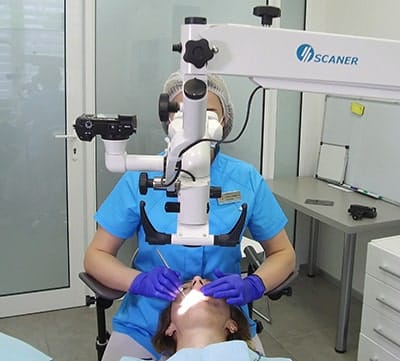
All root canal treatment is performed under a dental microscope, which allows the dentist to get to the tiny cavities of the canal. These are invisible to the naked eye, and even a magnifying glass is not strong enough to detect and treat all the parts of the canal that contain bacteria. Without treatment, these bacteria will continue to cause inflammation that leads to tooth loss.
Root canal restorationAfter the anesthesia from the procedure wears off, you may feel some form of pressure or discomfort. During the root canal repair, try not to chew on the affected tooth until the pain is gone, this will help the tissues heal faster.
Teeth after canal treatmentAfter root canal treatment, most teeth become more brittle and break or chip more easily. Once a permanent dental crown is placed over the remnants of the tooth, you will not feel any difference between the treated tooth and your other natural teeth.
At City Smile Clinic, any endodontic treatment is performed using a high-precision, state-of-the-art dental microscope.
Our specialists can offer you a comfortable and effective treatment that will result in quality fillings and preservation of the damaged tooth.
Root canal treatment can help you save a tooth that would otherwise have to be extracted due to damage, decay, or infection.
Can root canal treatment be performed under a microscope on a previously treated tooth?Yes. Our microscope allows us to perfectly clean a root canal that was previously treated.
Why is root canal treatment under a microscope more expensive?In addition to the device being very expensive, the equipment and materials used in the procedure make microscopic root canal treatment more expensive. However, experts recommend microscopic root canal treatment because traditional treatment cannot guarantee a 100% result. In addition, if the treatment fails, dentures will be required.
What is root canal treatment under a microscope?It’s a a processin which the dentist in in the process of treatment examines the root canal under a special microscope that detects even the smallest causes of inflammation or pain. Conventional root canal treatment (without a microscope) is effective in many cases. But sometimes the root canal is so narrow that the problem pulp of the tooth is difficult to see and remove. Even the most complex cavities and lesions can be easily located under a microscope.
What kind of root canals do teeth have?Human teeth come in several types, and each specific type has a certain number of roots.
Are dental microscopes common?Currently, dental microscopes are not often found in Ukraine. Such equipment has a high cost, and its use requires dentists with experience in root canal treatment.
| Primary Endodontic Treatment of a One- or Two-Canal Tooth | from 6 920 UAH |
| Removal of a Post from the Root Canal | from 1 090 to 2 450 UAH |
| Removal of a Broken Instrument Fragment from the Root Canal | 3 680 UAH |
| Retreatment of a One- or Two-Canal Tooth | from 8 290 UAH |
| Consultation with a specialist doctor | 850 UAH |
| Dental Check-Up | 1 750 UAH |
| Emergency dental care | 1 340 UAH |
| Anesthesia | 160 UAH |
| SedationMedical sleep sedation | from 4 600 UAH |

