

You probably have a rough idea of what a bite is, but for the sake of accuracy, a simple definition is worthwhile. A bite is the relationship between the teeth of the upper and lower jaw when they come together. Usually, a bite is classified as normal or correct, when the teeth of the upper jaw are in close contact with the teeth of the lower jaw in a certain order and with proper alignment.
Interestingly, a correct bite is quite rare, occurring in about one person in ten. Most people have some degree of abnormality.
Obviously, bite can affect appearance (smile aesthetics), food chewing, and dental health, but it is actually much more complicated than that. The human body is a complex system, and it is correct to look at the problem of bite in a holistic way. This is what this article is all about.
Effect of bite on dental healthIt’s quite simple and straightforward: if the teeth are not aligned properly, the stresses of chewing on the teeth and periodontal tissues will be distributed unevenly, which can lead to these problems:
-
Cavities
An improper bite itself does not lead to tooth decay, but it can contribute to conditions that increase the risk of tooth decay. These include poor hygiene, when it is not possible to clean teeth from plaque and bacteria because of bite disorders, and increased strain on some teeth, which can wear down the enamel, making them more vulnerable to bacteria
-
Periodontal disease
It develops slowly but, unfortunately, almost inevitably. In most people with uncorrected bite disorders, the symptoms of periodontal disease in the form of tooth mobility appear from the age of 30-40 years.
-
Gingival recession
Increased stress on certain areas of the periodontium lowers the gum, exposing the roots of the teeth
By far the most obvious problem with significant bite irregularities. Teeth can be unevenly aligned, misaligned, misaligned, or overlapped, which can significantly affect the overall appearance of the smile and face.
Your bite can also affect the proportions of the teeth in your smile. For example, a deep bite, where the teeth of the upper jaw overlap the teeth of the lower jaw, can make the lower teeth appear short or the upper teeth appear too prominent.
An improper bite can also have an effect on shifting the midline of the smile or distorting the shape of the lips.
Effect of bite on the TMJ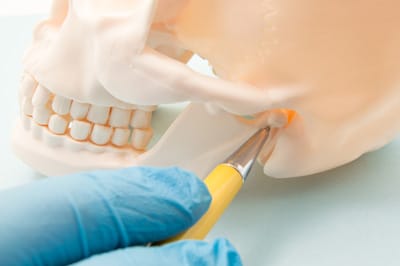 A misaligned bite in some cases leads to uneven stresses on the temporomandibular joints (which are responsible for clamping the teeth together), which can cause joint dysfunction that manifests itself as joint pain, limited jaw mobility, clicking when opening and closing the mouth, and other symptoms. Of course, such problems usually do not appear immediately, but arise with age. But it is much better to prevent them than to deal with the consequences.
Some types of malocclusion, such as a deep or open bite, can result in improper tooth contact when pronouncing sounds. This can make it difficult to accurately form sound patterns and result in unclear or distorted sounds.
Certain bite disorders affect the position and movement of the tongue when pronouncing sounds. For example, if the teeth overlap, the tongue may be forced to the back of the mouth, which can lead to slurred pronunciation of sounds.
Some bite abnormalities affect the position and movement of the lips when pronouncing sounds. For example, an open bite, where the upper and lower teeth do not touch together, makes it difficult for the lips to close properly for articulation.
A malocclusion can also lead to distortion of certain sounds, especially those that require close contact between the teeth or teeth and tongue. For example, the sounds “s”, “z”, “sh”, and “g” can be distorted by a bite defect.
Effect of bite on gastrointestinal functionIn some cases, an improper bite makes it difficult to pulverize (chew) food. Inadequate chewing can impede the primary stage of digestion, contributing to potential GI problems.
Chewing for too long due to bite disorders produces too much gastric juice, which also adversely affects the GI tract
Improper bite and headachesHeadaches, neck pain, tinnitus, and even migraines can also result from bite disorders.
These symptoms are not always associated with a malocclusion. Only an examination by a gnathologist can determine whether these symptoms are due to a bite disorder.
An improper bite can put pressure on the nerves that run through the face and neck, which irritates nerve fibers and contributes to headaches.
Bite abnormalities sometimes cause masticatory muscles, as well as neck and shoulder girdle muscles, to malfunction and strain. This increased muscle tension can spread upward to the face and head, causing tension and headaches.
Relation of malocclusion to postureSome types of bite disorders can lead to improper head and neck posture. For example, a deep or open bite tilts the head forward for proper tooth contact, which can create an imbalance in posture.
If the bite causes jaw misalignment and uneven load distribution on the muscles of the neck and shoulders – this also affects posture.
Methods of bite correctionIt is important to note that the relationship between malocclusion and posture can be complex, and each case is different. A consultation with a gnathologist should be sought to determine if there is a causal relationship.
Consideration of all methods of bite treatment is far beyond the scope of this article, so we will consider only the main ones, which are suitable for the vast majority of cases
-
braces
The most well-known and popular way of correcting various bite problems and anomalies remains braces. They consist of small metal or ceramic fixtures on the surface of the teeth, and an arch that passes through these fixtures and creates a constant pressure on the teeth, moving them into the desired position.When using braces, it is necessary to visit the orthodontist regularly for adjustments and replacements to ensure that the teeth move gradually. Treatment with braces usually takes a long time: from several months to several years, depending on the complexity of the bite problem.
Braces can also be used in combination with other orthodontic techniques, such as removable appliances or elastics, to achieve optimal results.
-
Plate apparatus
The principle of operation is based on the gradual exposure of the teeth and jaws with a plate that exerts a certain amount of pressure on the teeth.
They are more often used for bite alignment in children and adolescents. For adults, this treatment alone is ineffective, so plates are used in conjunction with bracket systems.
-
Eliners
Special individually made sets of removable transparent mouthguards that gradually move the teeth into the desired position in a pre-planned manner. The principle of operation is that the patient wears the mouth guards for the required time, after which the mouth guards are replaced by the next one, etc. Depending on the complexity of the situation, the number of mouth guards required for treatment can vary from 10 to 50. Eliners are a much more comfortable and discreet method of treatment than braces, but they are less universal (in particularly complex cases, braces are not necessary) and more expensive.
In order to understand whether you are a happy owner of a normal bite or whether your bite needs correction, we recommend that you undergo a bite diagnosis by the specialists of City Smile Clinic. Bite diagnostics allows to detect various anomalies and discrepancies in the position of teeth and jaws. Accurate diagnosis allows us to determine the nature and complexity of these anomalies and choose an appropriate treatment plan.
In general, treatment of malocclusion can take from several months to several years. The duration of treatment can be determined by the orthodontist after diagnosis and an individualized treatment plan. In more complex cases, such as severe crossbite or significant misalignment of teeth, longer treatment may be required – up to 3 years or even longer
How do I know if I have a bad bite?The best way to detect bite abnormalities is through diagnosis. But there are signs that you can recognize bite problems yourself: your teeth should be aligned so that the upper teeth slightly overlap the lower teeth. If the teeth are severely misaligned or overlapping, it may indicate a malocclusion. If you have problems chewing (jaw pain, difficulty grinding food, or a feeling that your teeth are not touching properly) this may indicate a malocclusion. If you have visible problems with the alignment of your teeth or the harmony of your facial features, it may also be related to a malocclusion.
What kind of specialist deals with bite correction?A specialist who deals with correcting the bite is called an orthodontist. Orthodontists are dentists who specialize in diagnosing, preventing, and correcting malocclusion and misalignment of the teeth and jaws. In some cases, when bite problems and TMJ dysfunction require a combined approach, a gnathologist – a specialist who examines the functioning of the dentoalveolar apparatus as a whole – may become involved.
Any questions?Call and we’ll be happy to answer them!
